
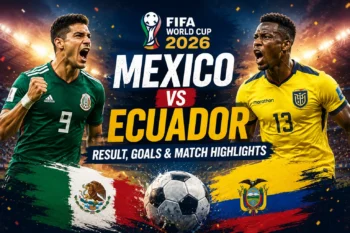
The atmosphere inside the iconic Estadio Azteca was electric. It perfectly matched the stormy, lightning-filled skies hanging over Mexico City. In a high-stakes, breathless encounter, El Tri finally shattered four decades of tournament heartbreak. Fans across the globe tracked the Mexico vs Ecuador clash in the FIFA World Cup 2026 Round of 32 with immense anxiety. Consequently, this was not just another football match. Instead, it was a profound exorcism of historical demons. With a commanding first-half blitz, Javier Aguirre’s men secured a clinical 2-0 victory. Therefore, they booked their long-awaited place in the Round of 16 and ignited nationwide celebrations.
The narrative surrounding Mexican football has been stubbornly defined by the infamous quinto partido (fifth game) curse. For many years, fans endured a painful streak of eight consecutive knockout-stage exits. However, on this tempestuous evening, history was boldly rewritten. Facing an Ecuador side that had recently defeated Germany in the group stage, El Tri displayed immense intensity. Furthermore, their tactical discipline and clinical finishing completely shell-shocked La Tri. Mexico emerged victorious because a blend of veteran experience and historical youth led the team. Thus, they left no doubt about their credentials as serious contenders on home soil.
Every blade of grass on the historic pitch felt the weight of expectation. Millions of eyes were glued to screens, watching every pass, tackle, and tactical shift. The tactical setups promised a chess match, but what unfolded was a display of pure passion. Mexico’s approach showed that they had learned from past disappointments. Consequently, they stepped onto the field with an unwavering sense of destiny.
Mexico vs Ecuador Result: El Tri Break the 40-Year Knockout Curse
When the final whistle blew, a deafening cacophony of cheers erupted from the partisan crowd. At that moment, the scoreboard told a definitive story: Mexico 2, Ecuador 0. This historic Mexico vs Ecuador result marks El Tri’s first victory in a World Cup knockout match since 1986. Back then, they defeated Bulgaria on home soil as well. Since that magical summer, generations of Mexican fans have endured heartbreak after heartbreak. Specifically, they suffered seven straight Round of 16 exits between 1994 and 2018. After that, they experienced a dismal group-stage elimination at Qatar 2022.
Ending the Knockout Drought
By securing this definitive win in the Mexico vs Ecuador Round of 32 stage, Javier Aguirre’s side officially ended the long drought. It was a flawless tactical performance. Moreover, it yielded Mexico’s fourth consecutive victory and fourth consecutive clean sheet of the tournament. For Ecuador, it was a bitter end to an otherwise promising campaign. They fell to an 0-2-0 all-time record in World Cup knockout fixtures because they struggled against an organized opponent.
The weight of history can either paralyze a team or propel them forward. On this night, it clearly did the latter. From the opening whistle, the Mexican players moved with a synchronized purpose. For instance, they shut down spaces and dominated the physical duels. The midfield engine room worked tirelessly to disrupt Ecuador’s transition play. As a result, the visitors could never establish a fluid rhythm. It was a victory built on solid defensive foundations and sharp efficiency.
Quick Match Summary: A Night of Drama in Mexico City
The match was delayed by an hour due to torrential rain and severe lightning over the capital. Consequently, it became only the second fixture in the entire tournament to be disrupted by severe weather. When the action finally commenced on the slick pitch, Mexico wasted no time. Driven forward by the roaring home support, the hosts completely blitzed the Ecuadorian defense in the opening 35 minutes. They capitalized on uncharacteristic errors and established a two-goal cushion quickly.
A Crucial First-Half Cushion
Julián Quiñones opened the scoring in the 22nd minute. He latched onto a brilliant through ball from Roberto Alvarado after a costly Ecuadorian turnover. Just nine minutes later, the veteran talisman Raúl Jiménez brought the house down. He produced a sublime, composed finish inside the box following a lightning-fast give-and-go with Quiñones. Ecuador attempted to find a lifeline in the second half. They dominated possession in the middle third, but they lacked creativity. Therefore, they failed to break down a rigid Mexican low block. The night concluded in absolute frustration for the visitors, culminating in a late straight red card for Piero Hincapié.
The weather drama only added to the cinematic feel of the evening. As thunder rumbled in the distance, the stadium lights reflected off the wet turf. This created a theater of high drama. Mexico adapted to the tricky underfoot conditions much faster than their South American counterparts. Specifically, they utilized short, crisp passes rather than risking long, unpredictable balls. This adaptability proved to be the cornerstone of their early dominance, allowing them to control the tempo perfectly.
Quick Facts: Mexico vs Ecuador
| Fixture | FIFA World Cup 2026 – Round of 32 |
|---|---|
| Date | June 30, 2026 |
| Venue | Estadio Azteca (Mexico City Stadium) |
| Final Score | Mexico 2 – 0 Ecuador |
| Goal Scorers | Julián Quiñones (22′), Raúl Jiménez (31′) |
| Discipline | Piero Hincapié (Red Card – 90+5′) |
| Attendance | 87,500+ (Sold Out) |
Mexico vs Ecuador Goals: A Detailed Look at the First-Half Blitz
The defining moments of this titanic clash arrived during a blistering opening period. During these minutes, Mexico tore the tactical plans of Sebastián Beccacece to shreds. They used individual brilliance and collective pressing to achieve this. The opening Mexico vs Ecuador goals highlighted the stark difference in sharpness between the two sides. Let’s analyze exactly how Mexico carved open one of South America’s most stubborn defensive units.
The Breakthrough: Julián Quiñones (22nd Minute)
After weathering an initial physical opening ten minutes, Mexico began utilizing the wide areas. They did this to exploit Ecuador’s narrow 4-4-2 formation. The breakthrough came when Érik Lira intercepted a loose pass from Moisés Caicedo deep in the midfield. Lira quickly fed the ball to Roberto “El Piojo” Alvarado on the right flank. Alvarado showed immense vision. He drifted inside before slipping a perfectly weighted through ball into the path of Julián Quiñones. The powerful forward timed his run to perfection. He escaped the clutches of Joel Ordóñez and rifled a powerful low shot past Hernán Galíndez. The stadium erupted as VAR quickly confirmed the goal.
The significance of this opening goal cannot be overstated. Clearly, it settled any lingering pre-match nerves and forced Ecuador to alter their defensive posture. Quiñones celebrated with unbridled joy. He slid on his knees toward the corner flag as his teammates swarmed him. The tactical preparation for this specific sequence was evident. Mexico knew Caicedo tended to hold onto the ball too long under pressure, and Lira anticipated it perfectly.
The Cushion: Raúl Jiménez (31st Minute)
With momentum firmly behind them, El Tri hunted for a second goal. It arrived less than ten minutes later through an absolute masterclass in technical combination play. Receiving the ball with his back to goal, the 35-year-old Raúl Jiménez played a rapid give-and-go with Quiñones. Quiñones delivered a delicate return pass over the top of Willian Pacho. Jiménez controlled the ball effortlessly on his thigh and slotted a clinical strike into the bottom-left corner. It was a goal of pure beauty, leaving Galíndez with absolutely no chance.
Jiménez’s strike was a testament to his enduring class and intelligence. While many doubted his inclusion as a starter, his ability to link play justified Aguirre’s faith completely. The stadium shook to its foundations at that moment. Fans realized that a two-goal lead against an excellent defensive team was a massive step toward breaking the curse.
Goals Timeline Mexico vs Ecuador
| Minute | Event | Team | Description |
|---|---|---|---|
| 22′ | Goal (1-0) | Mexico | Julián Quiñones scores with a low drive following an assist from Roberto Alvarado. |
| 31′ | Goal (2-0) | Mexico | Raúl Jiménez doubles the lead with a composed finish after a swift give-and-go with Quiñones. |
| 45+1′ | Yellow Card | Ecuador | Alan Franco cautioned for a cynical tactical foul on Gilberto Mora. |
| 72′ | Substitution | Mexico | Luis Romo replaced by Obed Vargas to refresh the midfield energy. |
| 81′ | Substitution | Ecuador | Kevin Rodríguez comes on for John Yeboah in a desperate attacking move. |
| 90+3′ | Yellow Card | Ecuador | Kendry Páez booked for dissent after a refereeing decision. |
| 90+5′ | Red Card | Ecuador | Piero Hincapié sent off via VAR review for violating the strict mouth-covering rule during a confrontation. |
| 90+9′ | Yellow Card | Ecuador | Moisés Caicedo cautioned for a late, frustrated challenge on Obed Vargas. |
Mexico vs Ecuador Match Report: Complete First and Second Half Analysis
To fully understand how this tactical chess match unfolded, a comprehensive Mexico vs Ecuador match report must examine the coaching strategies. Javier Aguirre completely outmaneuvered his tactical counterpart across both halves. The pre-match tactical talk centered heavily on how Mexico would handle Ecuador’s robust midfield physical presence. However, Aguirre’s layout proved flawless, balancing defensive solidity with explosive transitional play.
First Half Analysis: High Pressing and Clinical Execution
Mexico deployed an aggressive 4-1-2-3 system. Their primary objective was clear from the opening whistle: deny Moisés Caicedo time and space on the ball. With Érik Lira operating as the defensive anchor, young starlet Gilberto Mora and the industrious Luis Romo pressed high up the pitch. This forced Ecuador into hurried clearances. Consequently, central defenders César Montes and Johan Vásquez swallowed up these loose balls effortlessly and recycled possession back into the attacking channels.
The strategy paid massive dividends. Ecuador’s forward line of Enner Valencia and Gonzalo Plata found themselves entirely isolated. They received little to no service from a suffocating midfield. Whenever La Tri tried to play out from the back, Mexico’s front three cut off the passing lanes with disciplined intensity. The two goals were a direct consequence of this suffocating pressure. By the time the halftime whistle blew, Mexico had registered five shots on target to Ecuador’s zero.
The tactical discipline shown by the wide players was particularly impressive. Alvarado and Quiñones did not just contribute to the attacking phases. In addition, they tracked back diligently to support their full-backs, preventing Ecuador from creating overlapping overloads on the wings. This complete team commitment frustrated Ecuador. They grew visibly agitated as the first half drew to a close, leading to several heavy challenges.
Second Half Analysis: A Masterclass in Defensive Resilience
Aguirre knew that Ecuador would have to throw caution to the wind. Therefore, he instructed his side to drop into a disciplined, compact low block for the second half. Sebastián Beccacece made immediate changes at the break. He introduced Yaimar Medina and Ángelo Preciado to inject pace into the wide areas. While Ecuador successfully managed to dominate possession in the middle third of the pitch, they ran into a literal green wall every time they approached the penalty box.
Ecuador earned eight corners over the course of the match, but Mexico’s aerial dominance was supreme. Goalkeeper Raúl Rangel commanded his box with immense confidence. He claimed crosses and calmed the game down at every opportunity. Meanwhile, Mexico still looked highly dangerous on the counter-attack. In the 67th minute, a superb corner from Alvarado found César Montes. His bullet header required a miraculous point-blank reflex save from Galíndez to prevent a third goal.
The maturity displayed by Mexico in the closing twenty minutes was a stark departure from previous tournament iterations. Instead of panicking under sustained territorial pressure, El Tri remained calm. They tracked runners, blocked passing lanes, and utilized smart fouls to break up Ecuador’s attacking momentum. The introduction of fresh legs in midfield further solidified this defensive structure, completely killing off any hopes of an Ecuadorian comeback.
Tactical Analysis: How Javier Aguirre Outsmarted Sebastián Beccacece
The tactical battle in this edition of the México – Ecuador rivalry was a showcase of contrasting footballing philosophies. Beccacece stuck to a rigid 4-4-2, banking on the physical dominance of Caicedo and Franco to control the tempo. However, Aguirre’s tactical fluidity completely exposed the structural flaws in the Ecuadorian setup. He showed why structural adaptability is paramount in tournament football.
Creating the Numerical Overload
Aguirre deployed the 17-year-old sensation Gilberto Mora in an advanced central role. By doing this, he created a persistent numerical overload in the half-spaces. Ecuador’s central midfielders were constantly forced to choose between tracking Mora’s intelligent off-the-ball runs or staying compact. This indecision pulled Piero Hincapié and Willian Pacho out of position, opening up massive gaps for Quiñones and Alvarado to exploit.
Full-Back Rotation and Preventive Defense
Furthermore, Mexico’s transition from an aggressive press in the first half to a deep counter-attacking shape in the second half demonstrated incredible tactical maturity. Another fascinating aspect of Aguirre’s game plan was the positioning of full-backs Jorge Sánchez and Jesús Gallardo. Rather than bombing forward simultaneously, they rotated their attacking runs carefully.
When Sánchez pushed high up the right wing to assist Alvarado, Gallardo tucked inside to form a temporary three-man defensive backline alongside Montes and Vásquez. This preventive defensive positioning meant that even if Mexico turned the ball over, they were never exposed to a quick Ecuadorian counter-attack. Thus, they completely neutralized the dangerous pace of Gonzalo Plata.
Team Statistics: A Comparative Breakdown Mexico vs Ecuador
The numbers behind the 90 minutes provide an accurate reflection of how the match was won and lost. While the possession statistics might suggest a closely contested game, the efficiency metrics reveal Mexico’s utter dominance in the areas that truly mattered, particularly in shot accuracy and defensive interventions.
Match Statistics
| Metric | Mexico | Ecuador |
|---|---|---|
| Possession | 44% | 56% |
| Total Shots | 12 | 9 |
| Shots on Target | 6 | 2 |
| Passing Accuracy | 81% | 85% |
| Corners Earned | 4 | 8 |
| Fouls Committed | 11 | 14 |
| Yellow Cards | 0 | 3 |
| Red Cards | 0 | 1 |
Mexico vs Ecuador Player Ratings: Outstanding Performers in Green
Every single player in a green shirt executed their role to absolute perfection. However, a few individual displays stood out on this historic night. Here are the comprehensive Mexico vs Ecuador player ratings from the epic knockout clash at the Azteca, highlighting the heroes of this unforgettable victory.
Mexico Player Ratings
- Raúl Rangel (7.5/10): He looked incredibly composed under immense pressure. He kept a vital clean sheet, commanded his penalty area excellently during heavy rain, and made two crucial saves from distance.
- Jorge Sánchez (7.0/10): He delivered a tireless, combative performance on the right flank. He completely locked down John Yeboah and provided a constant, reliable outlet during transition phases.
- César Montes (8.5/10): He stood like an absolute mountain in the heart of defense. He won every single aerial duel, made five critical clearances, and was unlucky not to score with a header.
- Johan Vásquez (8.0/10): He complemented Montes perfectly. He read the game with elite precision, cutting out several dangerous low crosses from Preciado and organizing the defensive line.
- Jesús Gallardo (7.5/10): He showed his immense veteran experience under knockout conditions. He locked down his flank and tracked Gonzalo Plata’s inverted runs diligently throughout the match.
- Érik Lira (8.0/10): He was the unsung hero of the midfield engine room. He broke up countless Ecuadorian attacks and initiated the sequence for the opening goal with a sharp interception.
- Gilberto Mora (8.5/10): He produced a historic display. The 17-year-old showed technical skills far beyond his years, gliding past challenges and driving Mexico forward with immense confidence and vision.
- Luis Romo (7.5/10): He provided incredible tactical coverage in the engine room. He pressed high up the pitch and protected his backline superbly before being substituted late to a standing ovation.
- Roberto Alvarado (8.5/10): He was absolutely magnificent on the wing. He provided a majestic, perfectly weighted assist for the first goal and remained a constant threat with his pinpoint crossing ability.
- Raúl Jiménez (9.0/10) – Man of the Match: He delivered a legendary performance. He scored a world-class goal, held up the ball flawlessly under physical pressure, and led the defensive press like a general.
- Julián Quiñones (8.5/10): He was clinical, direct, and incredibly dangerous. He took his opening goal beautifully and provided the vital assist for Jiménez to double the lead, tormenting the opposition full-backs.
Ecuador Player Ratings
- Hernán Galíndez (6.5/10): He could do very little about either goal due to defensive lapses. However, he made a truly world-class reflex save to deny Montes in the second half to keep the score respectable.
- Piero Hincapié (4.0/10): This was a night to forget for the talented defender. He struggled with Alvarado’s movement all night and received a costly red card deep in stoppage time for a disciplinary infraction.
- Willian Pacho (5.5/10): The rapid give-and-go sequence between Jiménez and Quiñones caught him out of position for the second goal, leaving too much space in the box.
- Moisés Caicedo (6.0/10): He worked incredibly hard but the organized Mexican midfield press completely swarmed him. Furthermore, he committed a bad turnover that led directly to the opening goal.
- Enner Valencia (5.0/10): He was starved of service throughout his time on the pitch. He cut an isolated, deeply frustrated figure before the coach substituted him early in the second half.
Key Moments: The Red Card Drama and Historic Milestones
Aside from the brilliant goals, the match featured highly significant moments. These events sent shockwaves through the tournament structure. The most controversial incident occurred in the 95th minute during a heated confrontation. Ecuador’s Piero Hincapié and Mexican substitute Brian Gutiérrez faced off near the touchline. Following a heavy challenge, the two players came together face-to-face in an intense verbal exchange. Hincapié deliberately covered his mouth with his jersey while speaking to Gutiérrez.
The Strict New Mouth-Covering Directive
Under the strict new directives introduced for the tournament, players are strictly prohibited from covering their mouths when addressing opponents or officials. This rule aims to prevent unsporting language, racial slurs, and hidden abuse on the pitch. Consequently, the video assistant referee promptly called the center official to the VAR monitor. Upon reviewing the audio-visual footage, the referee brandished a straight red card to Hincapié. It was a dramatic validation of the tournament’s new disciplinary framework. Ultimately, it compounded a miserable night for La Tri.
Mora and Jiménez Record Historic Milestones
On a much brighter note, teenage midfielder Gilberto Mora created footballing history. At just 17 years and 259 days old, he became the second-youngest player ever to start a World Cup knockout match. He trails only the legendary Pelé, who achieved the feat at 17 years and 239 days during the iconic 1958 tournament in Sweden. Additionally, at 35 years and 56 days old, Raúl Jiménez became the oldest Mexican player ever to score in a World Cup knockout match, highlighting the perfect blend of youth and experience steering this historic team.
The contrast between Mora’s youthful exuberance and Jiménez’s calm experience perfectly encapsulates this modern Mexican squad. While Mora provided the unpredictability and creative spark that opened up spaces, Jiménez offered the tactical positional awareness needed to kill games off. This balance is something Mexico has lacked in past tournaments. Previously, squads were either too reliant on aging stars or too inexperienced to handle the immense pressure of knockout football.
What’s Next: The Long Road to the Quarter-Finals
With their ancestral knockout curse emphatically broken, Mexico can now look forward to a blockbuster Round of 16 matchup. This prospect has captured the imagination of sports journalists worldwide. Javier Aguirre’s men will return to the hallowed grounds of the Estadio Azteca on Sunday, July 5. On that day, they will face the winner of the highly anticipated clash between England and DR Congo. Given their current blistering form, cohesive tactical identity, and roaring home support, El Tri will enter the next round with immense belief.
Preparing for Elite Opposition
To fully prepare for the upcoming tactical challenges and historical contexts, fans can read our comprehensive guides. For example, check out our complete guide to the FIFA World Cup 2026 First Match to understand how the tournament’s opening dynamics set the stage for this spectacular knockout run. For Ecuador, the post-mortem begins immediately. Sebastián Beccacece faces intense tactical scrutiny over his conservative setup. Therefore, the squad must regroup as they look ahead to the next cycle of South American qualifiers.
The upcoming match represents a massive step up in quality, regardless of who emerges victorious between England and DR Congo. Aguirre is well aware that elite European or African opposition might not repeat the tactical errors committed by Ecuador. Consequently, the coaching staff will undoubtedly spend the next few days analyzing tape. They want to ensure that the defensive shape remains flawless while looking for ways to maximize the counter-attacking potential of Quiñones and Alvarado.
Mexico vs Ecuador Match Analysis: Expert Tactical Takeaways
Deep tactical deconstruction of this fixture reveals that Mexico’s success was fundamentally rooted in their impeccable spatial control. In previous tournaments, Mexican sides often fell victim to over-possessing the ball in non-dangerous areas. This tendency left them highly vulnerable to rapid counter-attacks. However, in this specific Mexico vs Ecuador match analysis, the statistics clearly show a shift. Mexico intentionally surrendered possession (44%) to compress the spaces between their defensive and midfield lines, prioritizing structure over stylistic dominance.
Neutralizing Ecuador’s Explosive Transition Speed
This approach completely neutralized Ecuador’s greatest strength: their explosive transitional speed through the wings. By forcing Ecuador to build slowly from the back, Mexico exposed their opponent’s distinct lack of a creative playmaker in the final third. It was a mature, calculated approach. This proves Javier Aguirre has successfully instilled an elite, pragmatic tournament mentality within this squad. El Tri are no longer just an entertaining side that plays beautiful football. Instead, they are a highly pragmatic, defensive machine capable of grinding out results under maximum pressure.
Furthermore, the role of Érik Lira as a single pivot cannot be overstated. By sitting directly in front of the center-backs, he allowed Mora and Romo to hunt for interceptions further up the pitch. They did this without fear of leaving the central defense exposed. This tactical insurance policy completely nullified Enner Valencia’s ability to drop deep and link play. Thus, it effectively cut off the head of Ecuador’s attack in a masterclass of tactical containment.
Tournament Impact: How the Bracket Shapes Up
The repercussions of this historic result reverberate far beyond Mexico City. By advancing to the Round of 16, Mexico has solidified their position as a genuine powerhouse in this expanded tournament format. The addition of the Round of 32 phase was met with some skepticism prior to the tournament. Critics argued it would dilute the quality of the knockout rounds. However, matches of this intensity and tactical quality have completely vindicated FIFA’s decision, providing fans with unparalleled drama.
A Massive Statement for CONCACAF
For the North American region (CONCACAF), Mexico’s progression is a massive statement of intent. The tournament is being co-hosted across Canada, Mexico, and the United States. Therefore, the pressure on the host nations to perform has been immense. Mexico’s ability to handle this pressure and dispatch an elite CONMEBOL opponent sends a clear message to the rest of the footballing world. Playing El Tri on their home turf is a daunting task for any team. The home-field advantage at the Azteca, combined with the altitude and passionate fans, creates an environment that is nearly impossible to conquer.
Ecuador’s Premature Exit and Reflection
Meanwhile, Ecuador’s exit leaves a significant void. La Tri entered the knockout stage with high expectations after a stellar group stage performance. Consequently, their premature elimination will lead to a period of intense reflection within the Ecuadorian Football Federation. The talent pool within Ecuador remains incredibly bright. Young stars like Moisés Caicedo and Piero Hincapié play at the absolute highest levels in Europe. However, this tournament has highlighted a crucial lack of tournament experience and tactical flexibility when facing highly organized defensive units, an area they must address soon.
Historical Context: Turning the Page on Decades of Disappointment
To truly appreciate the scenes of pure joy that erupted across Mexico, one must understand the deep psychological trauma that has plagued the nation’s footballing history. Since 1986, the Round of 16 had become an insurmountable barrier. It was a psychological wall that seemed to grow taller with each passing tournament. Whether it was the agonizing penalty shootout loss to Bulgaria in 1994, the tactical collapse against Germany in 1998, or the heartbreaking late goals against Argentina in 2006 and the Netherlands in 2014, Mexico always found a way to fall just short of the quarter-finals.
Aguirre’s Cold, Ruthless Professionalism
This victory represents a clean break from that painful past. Javier Aguirre, now in his third stint as national team manager, has finally succeeded where so many of his predecessors failed. Specifically, he has stripped away the anxiety that often paralyzed past Mexican teams on the big stage. He replaced it with a cold, ruthless professionalism. The players did not look like they were carrying the weight of 40 years of failure. Instead, they looked like a team fully focused on the 90 minutes in front of them, executing their tactical roles with clinical precision.
Establishing Regional Dominance
This win also marks a significant milestone in the long-standing footballing rivalry between Mexico and Ecuador. While matches between these two nations have traditionally been highly competitive affairs in the Copa América and international friendlies, facing each other in a World Cup knockout match raised the stakes to an unprecedented level. By securing a dominant, clean-sheet victory, Mexico has firmly established its superiority in this modern cycle. Thus, they set a benchmark for future generations of El Tri players to follow.
Frequently Asked Questions (FAQs)
What was the final score of the Mexico vs Ecuador match?
Mexico defeated Ecuador 2-0 in their FIFA World Cup 2026 Round of 32 knockout match at the Estadio Azteca.
Who scored the goals in the Mexico vs Ecuador World Cup clash?
The goals were scored by forward Julián Quiñones in the 22nd minute and veteran striker Raúl Jiménez in the 31st minute.
Why was the Mexico vs Ecuador match delayed before kickoff?
The highly anticipated fixture was delayed by exactly one hour due to heavy torrential rain and severe lightning over Mexico City, ensuring player safety.
Why did Piero Hincapié receive a straight red card during the match?
Hincapié was sent off deep in stoppage time following a VAR review for violating strict tournament rules regarding covering one’s mouth with a jersey during an on-field confrontation.
What historic record did Gilberto Mora break during Mexico vs Ecuador?
At 17 years and 259 days old, Gilberto Mora became the second-youngest player in football history to start a World Cup knockout match, behind only Pelé.
Who won the official Man of the Match award?
Raúl Jiménez earned the Man of the Match award for his world-class hold-up play, exceptional leadership, and clinical first-half goal.
When was the last time Mexico won a World Cup knockout match?
Prior to this victory, Mexico’s last knockout stage win came in 1986, when they defeated Bulgaria 2-0 on home soil, also at the Estadio Azteca.
Who will Mexico play next in the Round of 16?
Mexico will advance to the Round of 16 to face the winner of the highly anticipated knockout match between England and DR Congo.
Where can I watch the official Mexico vs Ecuador highlights?
Official match summaries and comprehensive Mexico vs Ecuador highlights are available globally via FIFA’s digital platforms and official broadcast partners like FOX Sports.
How many consecutive knockout stage losses did Mexico snap with this win?
With this historic 2-0 victory, Mexico successfully snapped an unwanted streak of eight consecutive knockout-stage eliminations dating back to 1994.
What tactical formation did Javier Aguirre use against Ecuador?
Javier Aguirre deployed a highly flexible 4-1-2-3 formation that shifted into a compact 4-5-1 defensive low block during the second half of the match.
How many total shots on target did Ecuador manage during the match?
Ecuador was limited to just 2 shots on target out of 9 total attempts, a testament to Mexico’s incredible defensive organization and structural discipline.
Conclusion: A Legendary Milestone for El Tri
The definitive 2-0 victory for Mexico over Ecuador will forever be viewed as a watershed moment for North American football. By executing a flawless tactical game plan, weathering a literal pre-match storm, and dispatching a highly formidable South American opponent, El Tri have successfully shed the heavy weight of historical underachievement. The curse of the knockout rounds is officially dead, buried deep beneath the hallowed turf of the Estadio Azteca.
As the team shifts its focus to the looming challenges of the Round of 16, the entire nation stands united in newfound tactical belief. Under Javier Aguirre’s masterly guidance, this team possesses the perfect formula to go all the way in this tournament. The perfect blend of ruthless clinical finishing, youthful exuberance, and impenetrable defensive stability means that Mexico is no longer just hosting the global party. Instead, they are fully prepared to win it all, writing a glorious new chapter in football history.